
Justice is not a request. It is a demand.
Our Demands
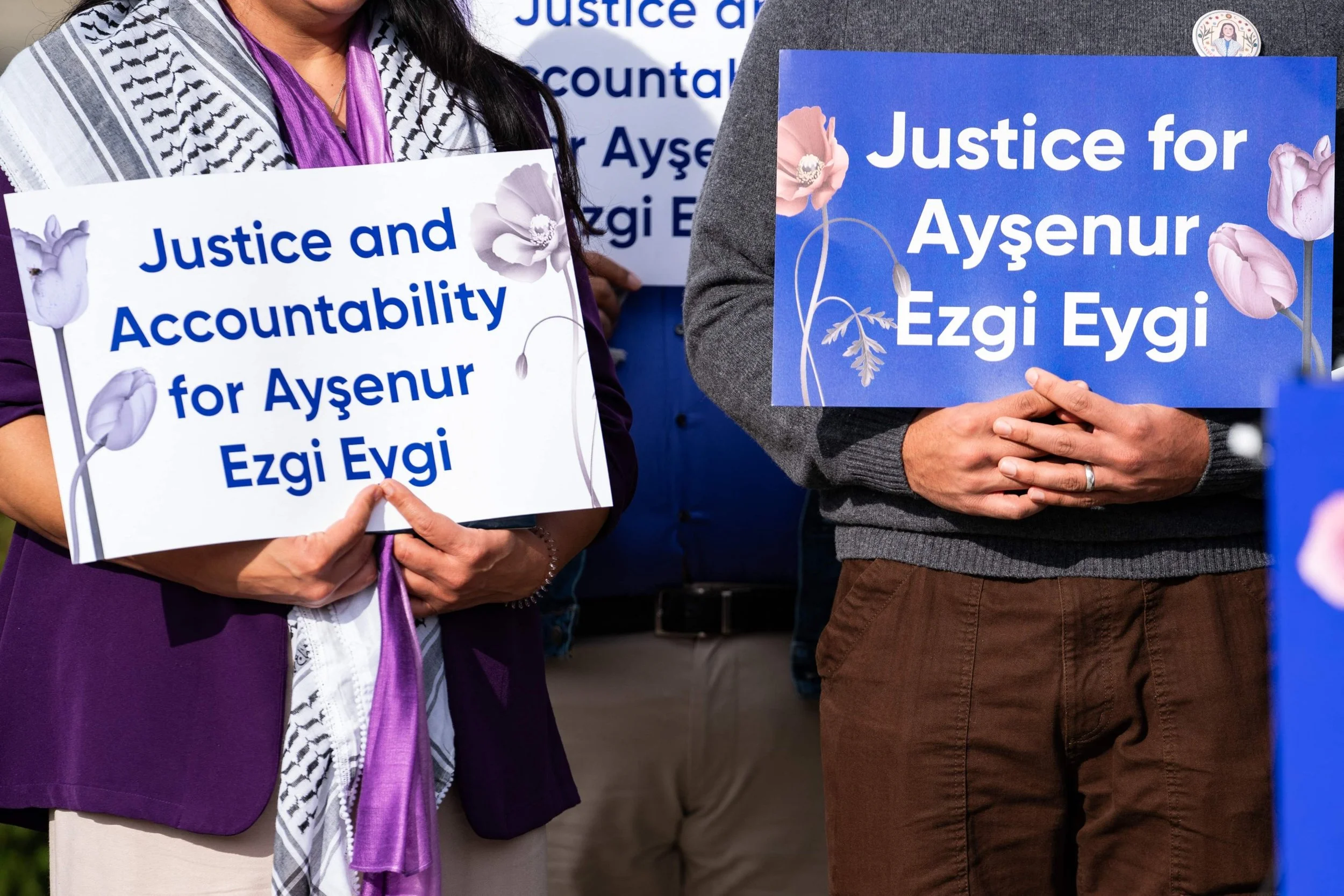
Our four pillars of justice and accountability.
A Full, Independent U.S. - Led Investigation
01
The killing of an American citizen by a foreign military requires an investigation that is independent, transparent, and not conducted by the party responsible. This is true for all Americans killed abroad. We demand the United States government formally open an independent investigation into the circumstances of Aysenur's death.
Internal IDF investigations are not, and have never been, credible mechanisms for accountability.
Criminal Accountability for Those Responsible
02
The soldier or soldiers who fired the shot that killed Aysenur, and any commanders who gave or authorized unlawful orders, must face criminal charges. Under international humanitarian law, the deliberate or reckless killing of a civilian, including an international observer, constitutes a serious violation requiring prosecution.
We demand that the United States use every diplomatic and legal tool available to pursue this accountability, including the application of the Leahy Law, which prohibits U.S. military assistance to units credibly accused of human rights abuses.
Congressional Hearings on the Killing
03
We demand that Congress hold formal public hearings into the killing of Aysenur Ezgi Eygi. American citizens deserve to know what the U.S. government knew, what was communicated to Israeli authorities, and why no meaningful action has followed months of stated concern.
The House Foreign Affairs Committee and Senate Foreign Relations Committee have both the authority and the obligation to conduct oversight. Silence from Congress is complicity.
Formal Diplomatic Consequences
04
Words are not enough. The U.S. government must impose formal diplomatic consequences proportionate to the gravity of the act, in this case, the killing of an American citizen engaged in protected civilian activity. This includes, at minimum, a formal diplomatic protest, suspension of relevant aid, and a public statement of consequence from the highest levels of the U.S. government.
The pattern of American citizens being killed in occupied Palestinian territory without consequence must end.
Accountability Tracker
Where things stand today
Four demands. Zero action.
| # | Demand | What it requires | Status |
|---|---|---|---|
| 01 | Full, U.S.-led independent investigation | A credible inquiry into Ayşenur's killing, independent of Israeli military review. | No action |
| 02 | Criminal accountability | Those responsible for her death must face criminal charges — not administrative review. | No action |
| 03 | Congressional hearings | Hearings on the pattern of killings of American citizens abroad with no accountability. | No action |
| 04 | Formal diplomatic consequences | The U.S. must respond with proportionate diplomatic action for the killing of its citizen. | No action |
Legal Context
Why International law demands accountability.
The killing of Ayșenur Ezgi Eygi is not merely a political matter. It is a legal one. International humanitarian law — binding on all states and armed forces — provides clear protections for civilians, including international observers, in conflict zones.
The Fourth Geneva Convention protects civilians in occupied territories. The Rome Statute defines the willful killing of civilians as a war crime. Customary international humanitarian law prohibits targeting civilians under any circumstances.
The United States, as a signatory to major international human rights treaties and as a permanent member of the UN Security Council, has both the legal obligation and the political power to act, and has chosen not to.
We are demanding that it live up to the obligations it has already accepted.
RELEVANT LEGAL FRAMEWORKS
— Fourth Geneva Convention (1949)
— Rome Statue of the International Criminal Court
— U.S. Leahy Law (22 U.S.C. §2378d)
— UN Declaration on Human Rights Defenders
— Hague Regulations on Laws of War
— U.S. Foreign Assistance Act
— International Covenant on Civil & Political Rights